
If you’ve ever stood beside a truck-mounted crane as it lifts a steel beam two stories high, or hoisted a 20,000-pound generator onto a rooftop, you might have noticed that big, heavy metal block hanging off the back of the truck. That’s the counterweight, and it’s not just a random extra weight bolted on for show. As a truck-mounted crane supplier who’s spent years troubleshooting these machines and walking operators through pre-lift checks, I can tell you the counterweight is the single most critical part of the crane’s balance system—skip setting it right, and even the most experienced operator can end up with a safety hazard that’s hard to fix. Let’s break down how it works, why it matters, and how our products like the 12-Ton Truck-Mounted Crane and 16-Ton Truck-Mounted Crane are built with counterweight systems tailored to keep jobs on site and crews safe.
First, let’s start with the basics: crane physics 101, simplified. When a crane extends its boom out to lift a load, that load creates what’s called a “tipping moment.” Think of a seesaw: if you sit on one end, you need weight on the other end to keep it from flipping over. That’s exactly what the counterweight does—its weight creates an opposite “restoring moment” that cancels out the tipping moment from the load. If the two moments are balanced, the crane stays stable; if the tipping moment is stronger, the whole thing can rotate backward around its rear axle (or the outrigger pad, if extended) and crash.
Most casual observers assume counterweights are just fixed, solid blocks that weigh a set amount, but that’s not true for modern truck-mounted cranes. A few decades ago, some small truck cranes used fixed counterweights, but today’s models (including all the ones I sell) have adjustable counterweight systems. Why? Because different lifts need different amounts of counterweight. Lifting a 5,000-pound air conditioner on a short boom only needs a small counterweight, but lifting a 25,000-pound HVAC unit on a fully extended boom needs a much heavier counterweight to balance the extra torque.
Let’s get specific about how that adjustable system works. For our 12-Ton Truck-Mounted Crane, the standard counterweight is 3,200 pounds, but we offer optional 1,800-pound add-on plates that can bolt onto the main counterweight bracket. Our 16-Ton Truck-Mounted Crane has a base counterweight of 4,500 pounds, with up to 2,200 pounds of add-on capacity. The way these attach is key: the counterweight mounts to the crane’s superstructure (the rotating part on top of the truck chassis) via heavy-duty pivot pins and mounting brackets, not just a few bolts. That means when the crane rotates 360 degrees for side lifts or lifts over the cab, the counterweight moves with it, always staying positioned opposite the boom and load to maintain balance.
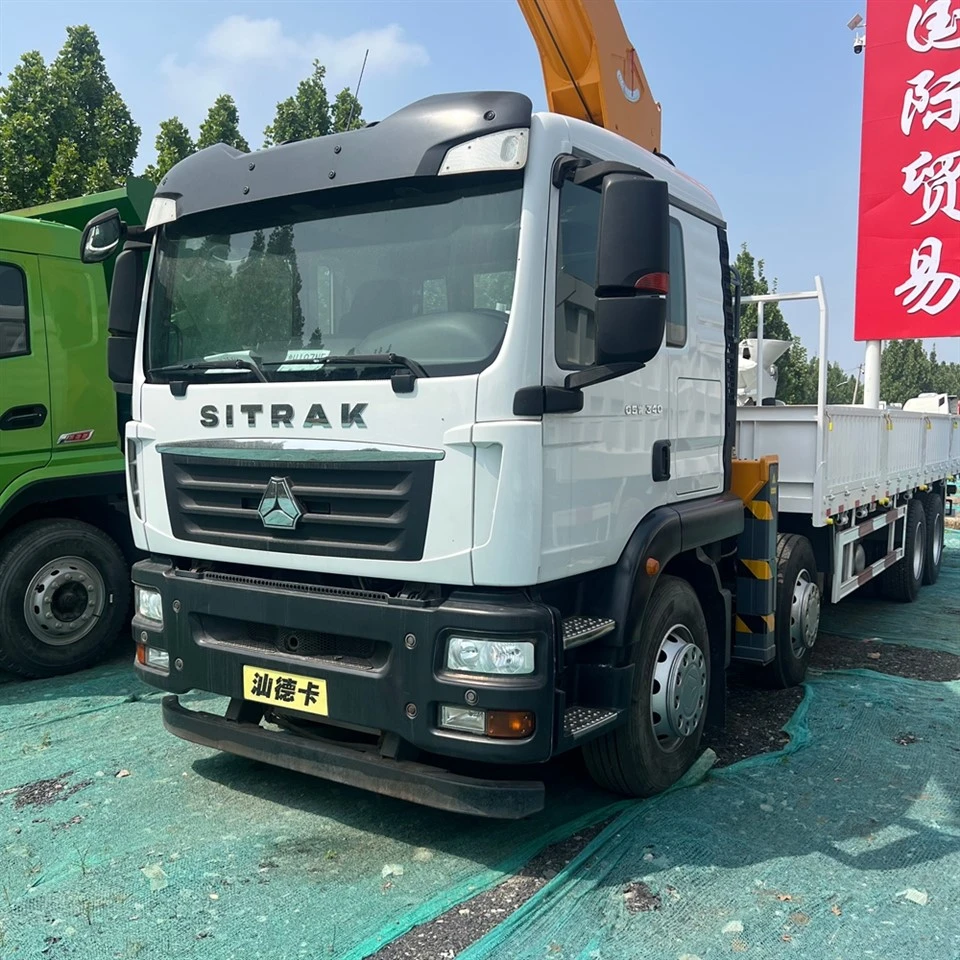

Wait, but what about when the crane isn’t on flat ground? That’s where operators get tripped up all the time. Even a 2-degree slope can throw off the balance—if the crane’s rear is lower than the front, the counterweight is sitting at an angle, so its effective weight (the force it exerts to create the restoring moment) is less than it should be. That’s why outriggers are non-negotiable for any lift over the rated capacity. Outriggers extend from the truck’s frame to distribute the crane’s total weight (including counterweight, boom, and load) across a larger area on the ground, and they also level the crane, so the counterweight sits parallel to the ground and delivers its full designed force. I’ve seen too many operators skip extending outriggers on a small lift just to save time, then find out the counterweight wasn’t positioned correctly for the slope, and almost tip the crane. It’s not worth the risk.
Another common misconception: the counterweight only works when the boom is extended. No—even when the boom is retracted, the counterweight has to balance the weight of the boom itself. A fully retracted boom still weighs several hundred pounds, so the counterweight can’t be removed entirely. In fact, our cranes have a lockout feature: you can’t remove the counterweight plates unless the boom is fully retracted and the crane is in transport mode, which is a built-in safety measure we added after a customer accidentally removed half the counterweight while prepping for a lift on a jobsite in Phoenix last year.
Let’s talk about rated capacity charts, because that’s where counterweight design shows up most clearly. Every truck-mounted crane has a printed (and digital, on modern models) rated capacity chart that tells you the maximum load you can lift at every boom length and every radius (the distance from the crane’s pivot point to the load). Let’s take our 16-ton model as an example. If the boom is at 20 feet (short, low radius), the maximum load is 12 tons with the base counterweight. If you extend the boom to 50 feet (longer radius), you need to add 1,000 pounds of counterweight to stay within the rated capacity, and at 70 feet, you need the full 6,700 pounds of counterweight (base plus add-ons). The chart doesn’t just pull numbers out of thin air—it’s calculated using the exact weight of the counterweight, its distance from the crane’s pivot point, and the boom’s length to balance the moments.
What about counterweight design for different truck sizes? A 12-ton truck-mounted crane is mounted on a smaller, more maneuverable chassis for urban jobsites where space is tight, so its counterweight has to be compact to fit between the truck’s rear wheels and the job site’s edge. If we put a huge counterweight on a compact chassis, it would stick out too far, making the crane hard to maneuver and increasing the risk of hitting power lines or buildings. That’s why our 12-Ton Truck-Mounted Crane uses narrow, stacked counterweight plates instead of a single block, so it stays within the truck’s wheelbase when in transport and only extends slightly when deployed. The 16-ton model is on a heavier chassis, so it can accommodate a larger, more massive counterweight without sacrificing mobility, which is why it’s better for heavier loads and longer booms on suburban and rural jobsites.
I should also mention dynamic loads, because static balance is only part of the story. When you lift a load, there’s inertia—when you start lifting, swinging the load, or lowering it, that adds extra force to the tipping moment, even if the load’s static weight is within the chart. A good counterweight system is designed to handle these dynamic forces, not just static ones. Our cranes use high-tensile steel for counterweight components and precision-engineered mounting brackets that flex slightly to absorb sudden loads, instead of rigid metal that could fail if the operator moves the load too quickly. I always tell customers: if you’re lifting a load 30 feet high, slow down the swing and lift speed, because the extra force on the boom means the counterweight has to work harder to keep things stable.
Now, common mistakes I see customers make with counterweights. First, not checking the counterweight before every lift. I have a pre-lift checklist I send to every new client, and step one is checking that all counterweight plates are locked in place, no bolts are missing, and the pivot pins are fully seated. A loose counterweight plate shifted during transport can slide to the end of the bracket, reducing the restoring moment by a few thousand pounds—enough to tip the crane on a tight lift. Second, overloading the counterweight. Some operators think more is better, but adding extra counterweight can damage the crane’s superstructure and chassis over time, because it puts unnecessary stress on the frame. The rated capacity chart tells you exactly how much counterweight you need for each lift, and deviating from that is a fast way to wear out your crane or cause a breakdown mid-job. Third, not accounting for wind. On jobsites where wind is over 20 mph, the load and the boom act like a sail, adding extra tipping force. Some operators try to compensate by adding more counterweight, but that’s not the right fix—usually, you need to reduce the load or retract the boom to stay within the rated capacity. The counterweight is there to balance the crane’s own weight and the intended load, not to counteract unexpected wind forces.
If you’re in the market for a truck-mounted crane, the counterweight system should be a top consideration, not an afterthought. That’s why all our models are designed with adjustable, compact, and safety-focused counterweight systems tailored to different job sizes. Whether you’re working on a residential HVAC install that needs the maneuverability of our 12-ton model with its narrow counterweight, or a commercial construction project that requires lifting 15 tons of steel beams with our 16-ton model’s extended counterweight range, we’ve built our cranes to balance performance, mobility, and safety.
If you’re looking for a reliable truck-mounted crane with a counterweight system that’s engineered to handle real-world jobs, we can help. Our team has decades of experience matching the right crane to your specific needs, and we provide full operator training so your crew knows exactly how to set up counterweights, use rated capacity charts, and avoid common mistakes. Don’t take chances with safety on your next lift—reach out to our team today to discuss your requirements.
References:
- Crane Institute of America. (2022). Truck-Mounted Crane Stability Guidelines. CIC Publications.
- Smith, J. (2021). Mobile Crane Counterweight Design and Application. Construction Equipment Engineering Journal, 47(3), 112-128.
- International Organization for Standardization. (2019). Cranes—Mobile Cranes—Safety Requirements. ISO 10258:2019.