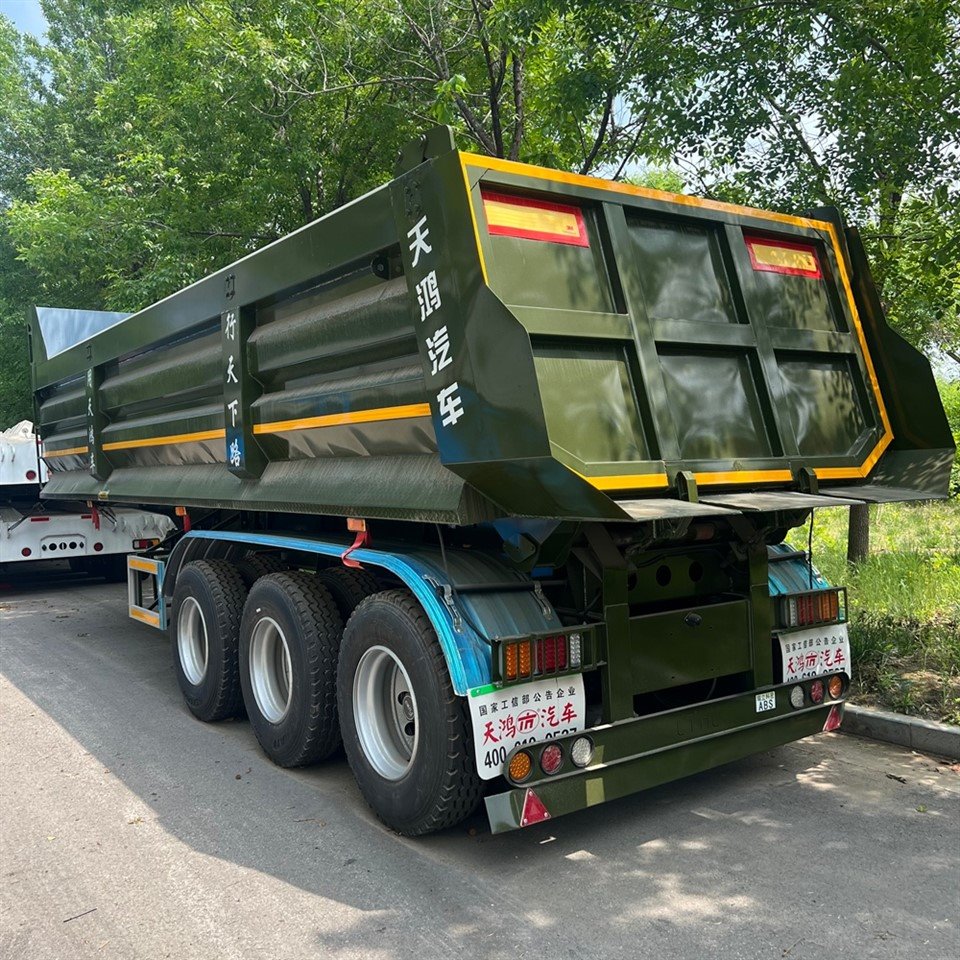


Rear-Tipping Dump Semi-Trailer - Introduction, Detailed Specifications & Operation Guide
Detailed Specifications
Basic Parameters
- Brand & Model: Heavy-Duty Rear-Tip Dump Semi-Trailer (optional configurations for different load levels, carriage sizes and working conditions, including standard version, reinforced version and light-weight version)
- Structure Type: Rear-tip dump structure, integral welded carriage, frame-type chassis; the tipping angle is 45°–55° (adjustable according to the type of goods), ensuring complete unloading without residue, which is suitable for various bulk materials with different fluidity.
- Wheelbase: 5600mm / 6000mm / 6500mm / 7000mm (optional configurations), matching different traction vehicles and transportation scenarios, adapting to the transportation needs of different lengths of bulk goods and different road conditions.
- Overall Dimensions (L×W×H): 10000–13000mm × 2400–2550mm × 3800–4200mm (varies with carriage length, height and additional configurations such as protective railings and fenders).

- Curb Weight: 8.5–11 tons (adopting high-strength steel plate, lightweight frame and aluminum alloy accessories, realizing lightweight design on the premise of ensuring load-bearing capacity, effectively improving the actual load capacity and transportation efficiency).
- Payload Capacity: 30–50 tons (different configurations for different load levels, meeting the transportation needs of light, medium and heavy bulk materials; the reinforced version can bear up to 50 tons, suitable for heavy-duty scenarios such as mining and large-scale construction sites).
- Gross Combination Weight (GCW): 40–60 tons (in line with global heavy-duty transportation standards, and can be customized according to local transportation regulations and traction vehicle matching requirements).
- Tire Specification: 12R22.5 / 295/80R22.5; 10–12 tires (optional), standard load-bearing high-strength tires, optional all-weather off-road tires for construction site scenarios, with strong wear resistance and load-bearing capacity, adapting to complex road conditions such as gravel roads and muddy roads.
Core Structure & Components
- Carriage: Made of high-strength wear-resistant steel plate (Q355B/Q460), thickness 6–12mm (bottom plate 10–12mm, side plate 6–8mm), integral automatic welding, high welding strength, not easy to deform or crack during heavy load and tipping. The inner wall of the carriage is smooth, with anti-sticking treatment, which can prevent bulk materials from adhering and ensure complete unloading; the rear door is equipped with a hydraulic locking device, which is tight and leak-proof, avoiding material leakage during transportation.
- Carriage Size: Length 6–10 meters, width 2.4–2.55 meters, height 1.8–2.2 meters (optional), can be customized according to the type and volume of goods; the reinforced version is equipped with side reinforcing ribs and bottom cross beams, further improving the load-bearing capacity and service life.
- Optional Configurations: Anti-collision protective railings, rear buffer device, side skirt, mudguard, and anti-theft device; for special goods (such as cement), a sealed carriage can be selected to prevent dust pollution and material dampness.
- Hydraulic Tipping System: The core component of the rear-tip dump semi-trailer, composed of hydraulic pump, hydraulic cylinder, control valve, oil tank and pipeline, providing stable power for carriage tipping and reset.
- Hydraulic Cylinder: 2–4 high-strength hydraulic cylinders (optional), single-cylinder or double-cylinder layout, with a maximum lifting force of 80–120 tons, ensuring smooth and stable tipping of the carriage even under full load; the cylinder body is made of high-strength seamless steel pipe, with corrosion resistance and wear resistance, and a service life of more than 80,000 hours.

- Control Mode: Manual control + electric control (optional), equipped with a control panel on the side of the trailer, which can easily control the lifting and lowering of the carriage; the electric control version supports remote control, which is more convenient and safe for operators to operate at a safe distance during unloading.
- Safety Features: Equipped with a hydraulic lock and a pressure relief valve, which can prevent the carriage from accidentally falling during tipping, ensuring the safety of personnel and equipment; the oil pipeline is made of high-pressure resistant rubber pipe, with good sealing performance, avoiding oil leakage.
- Chassis & Axles: The Rear-Tipping Dump Semi-Trailer features a high-strength rectangular tube frame that undergoes overall shot blasting for rust removal and corrosion protection, making it corrosion-resistant and long-lasting; equipped with heavy-duty axles (13-ton / 16-ton, 2–3 axles optional), matching high-quality bearings and brake systems, ensuring stable operation under heavy load.
- Axles: 13-ton maintenance-free heavy-duty axles as standard, 16-ton reinforced axles optional; the axle housing is made of high-strength cast iron, with strong load-bearing capacity and transmission efficiency; the brake system adopts drum brake or disc brake (optional), matching ABS anti-lock braking system and EBD electronic brake force distribution, ensuring braking safety under heavy load.
- Suspension System: Leaf spring suspension (standard) or air suspension (optional); the leaf spring suspension is made of high-quality spring steel, with strong shock absorption performance, adapting to bumpy road conditions such as construction sites; the air suspension has better shock absorption effect, reducing the damage of goods during transportation and improving driving comfort.
- Traction Device: Equipped with a high-strength traction pin (50# / 90# optional), made of alloy steel, quenched and tempered, with high hardness and impact resistance; the traction saddle is adjustable, adapting to different traction vehicles, ensuring stable connection during transportation and tipping.
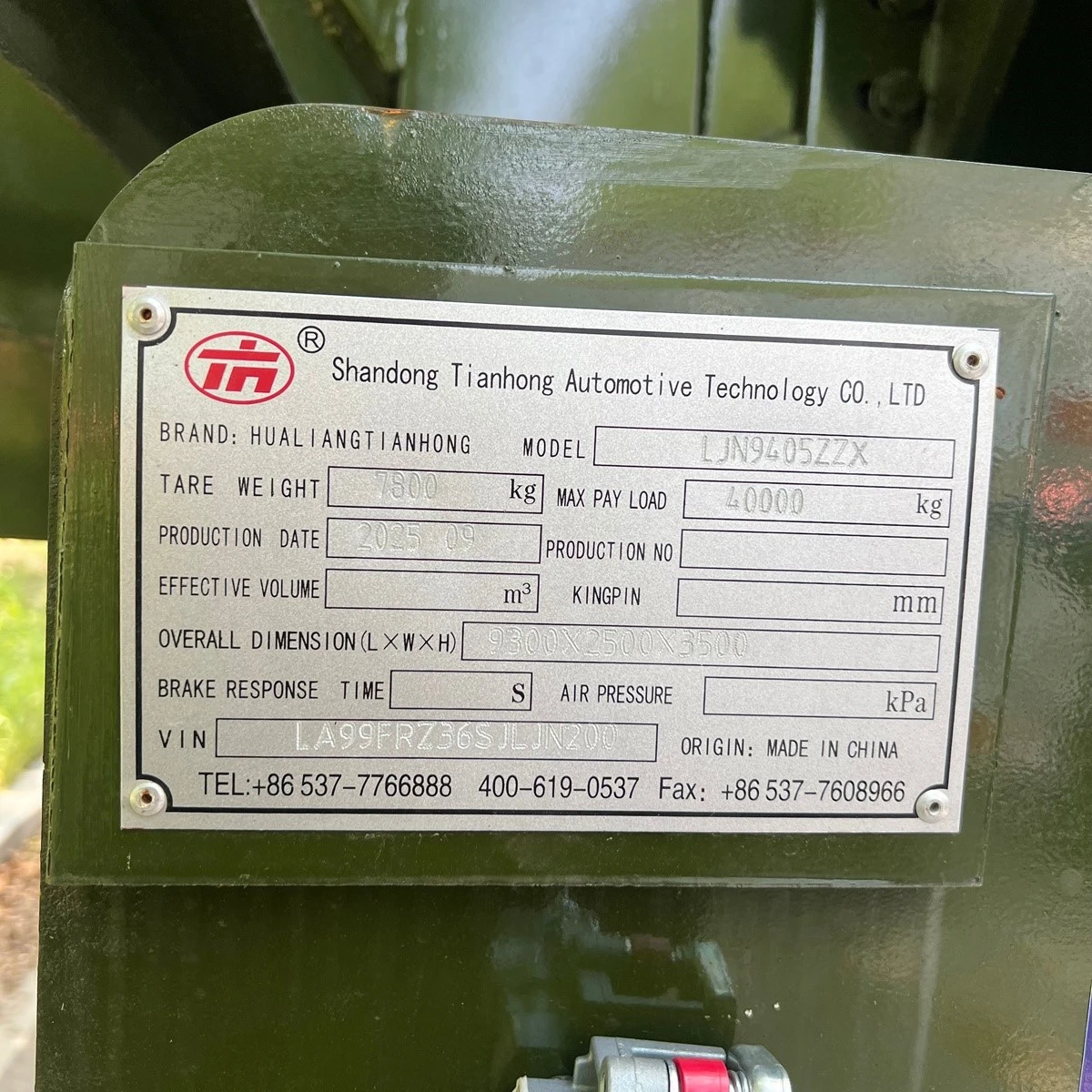
Safety & Auxiliary Configuration
- Safety Configuration: Comprehensive safety protection to ensure the safety of operation and transportation.
- Active Safety: ABS anti-lock braking system, EBD electronic brake force distribution, brake shoe gap automatic adjustment device as standard; optional LDWS lane departure warning and BSD blind spot monitoring, especially suitable for long-distance transportation and complex road conditions; the rear of the trailer is equipped with reflective signs and warning lights, improving visibility at night and in harsh weather.
- Passive Safety: Reinforced frame, anti-roll device, and rear buffer device; the carriage is equipped with a limit device, which can prevent excessive tipping and avoid equipment damage; the hydraulic system is equipped with an emergency descending valve, which can manually lower the carriage in case of power failure or hydraulic system failure, ensuring safety.
- Operation Safety: The control panel is equipped with a safety lock, preventing misoperation; the area around the hydraulic cylinder is equipped with a protective cover, avoiding injury to operators during operation; the rear door is equipped with a safety latch, ensuring tight locking during transportation.

Auxiliary Configuration:
- Daily Use: Equipped with a large-capacity hydraulic oil tank (100–150L), ensuring long-term operation without frequent oil addition; the oil tank is equipped with an oil filter, effectively filtering impurities and protecting the hydraulic system; the trailer is equipped with a toolbox, convenient for placing maintenance tools and accessories.
- Environmental Protection: Optional dust cover and sealed carriage, preventing dust pollution during transportation of bulk materials such as sand and coal; the mudguard is designed to prevent mud splashing, keeping the trailer clean and meeting environmental protection requirements.

Operation Guide
Pre-Operation Inspection
Before connecting the trailer to the traction vehicle and starting operation, conduct a comprehensive inspection to eliminate potential safety hazards and ensure normal operation, which is in line with the safety operation specifications of rear-tip dump semi-trailers:
- Structure & Carriage: Check the carriage for deformation, cracks or wear, especially the bottom plate and side plates; confirm the rear door is tightly locked, and the hydraulic locking device is working normally; check the inner wall of the carriage for material adhesion, and clean it in time if necessary; inspect the protective railings, fenders and rear buffer device for integrity and firmness, and tighten loose bolts in time.
- Hydraulic System: Check the hydraulic oil level in the oil tank to ensure it meets the standard; inspect the hydraulic pipeline, joints and hydraulic cylinder for oil leakage, and replace the damaged pipeline or seal in time; check the hydraulic control valve and pressure relief valve for normal operation, and test the manual and electric control functions to ensure the carriage can lift and lower smoothly; drain the accumulated water in the hydraulic oil tank in time, especially in low-temperature areas.
- Chassis & Axles: Check the tire pressure and wear condition of all tires, ensure wheel nuts are fastened; inspect the axles, bearings and suspension system for abnormal noise or looseness; check the brake system, including brake pads, brake drums and brake pipelines, to ensure braking performance is normal; confirm the traction pin and traction saddle are clean and free of wear, and the connection is reliable.
- Electrical & Safety Equipment: Test the warning lights, reflective signs and rear lights to ensure they work normally; check the safety lock of the control panel, emergency descending valve and other safety devices for normal operation; confirm the ABS system is working normally, and there is no fault alarm.
Connection with Traction Vehicle
- Drive the traction vehicle to the front of the trailer, keep the traction vehicle and trailer in a straight line, and slowly approach the trailer until the traction pin of the trailer is aligned with the traction saddle of the traction vehicle.
- Lower the traction saddle of the traction vehicle, make the traction pin insert into the traction saddle, and lock the traction saddle locking device; check to confirm the locking is reliable, and there is no looseness.
- Connect the air circuit and circuit connectors between the traction vehicle and the trailer, and test the trailer's brakes, lights and warning devices to ensure they work normally; connect the hydraulic pipeline (if the hydraulic system is powered by the traction vehicle), and check for oil leakage.
- Check the overall connection status, confirm the trailer is stable, and there is no tilting or looseness; remove the wheel blocks under the trailer's wheels, and confirm the surrounding environment is safe, without obstacles.
Loading & Transportation Operation
- Loading Operation: Drive the connected traction vehicle and trailer to the loading area, park the vehicle on a flat and solid ground, and pull the parking brake tightly; ensure the carriage is in the reset state, and the rear door is locked; load the bulk materials evenly into the carriage, avoid uneven loading or overloading, and the loading height shall not exceed the limit height of the carriage (to prevent material scattering during transportation); after loading, check the carriage for material overflow, and clean up the scattered materials in time.
- Transportation Operation: Before starting, confirm the carriage is locked, the hydraulic system is in the off state, and all safety devices are working normally; start the traction vehicle, and drive smoothly, avoiding violent acceleration, harsh braking and sharp turns, especially when transporting high-load goods, to prevent the trailer from tilting or materials from shifting.
- During transportation, maintain a stable speed: the maximum speed on highways shall not exceed 80km/h, and the speed on ordinary roads and construction site roads shall be controlled within 30–50km/h; when driving on bumpy roads, reduce the speed appropriately to reduce the impact on the trailer chassis and hydraulic system; pay attention to the road conditions, avoid potholes and obstacles, and prevent damage to the trailer.
- During long-distance transportation, stop regularly to inspect the trailer: check the traction connection status, tire pressure, hydraulic pipeline and brake system; check the carriage for material leakage, and deal with it in time if any problem is found; do not open the hydraulic system during transportation, to avoid accidental tipping of the carriage.
Unloading Operation
- Drive the traction vehicle and trailer to a flat, solid and open unloading area, ensure the ground can bear the weight of the full-load trailer, and there are no personnel, obstacles or flammable and explosive materials around the unloading area; pull the parking brake tightly, and place wheel blocks under the trailer's wheels to prevent the vehicle from sliding.
- Confirm the surrounding environment is safe, then turn on the hydraulic system, and operate the control panel (or remote control) to start lifting the carriage; during the tipping process, observe the carriage's lifting status, and ensure the lifting is smooth and stable, without abnormal noise or shaking; if the carriage tilts unevenly, stop lifting immediately, check the hydraulic system and carriage, and deal with the problem before continuing.
- When the carriage is lifted to the appropriate tipping angle (45°–55°, according to the type of goods), stop lifting, and wait for the goods to unload completely; during unloading, observe the goods' unloading status, and if there is material adhesion, use appropriate tools to clean it (do not stand under the carriage), ensuring no residue.
- After unloading is completed, operate the control panel to lower the carriage slowly, and reset it to the original position; confirm the carriage is completely reset, then turn off the hydraulic system, and lock the rear door.
- Clean up the scattered materials around the trailer, remove the wheel blocks, and check the trailer's hydraulic system, carriage and chassis for abnormalities before leaving the unloading area.
Post-Operation Maintenance
- After the operation is completed, park the trailer in a dry, ventilated and flat area, disconnect the connection with the traction vehicle, and place wheel blocks under the trailer's wheels; clean the carriage, remove the residual materials on the inner wall, and rinse the carriage with water if necessary (avoid washing the hydraulic system and electrical equipment).
- Inspect the hydraulic system: check the hydraulic oil level, replenish hydraulic oil in time if it is insufficient; clean the oil filter and oil tank, remove impurities and accumulated water; inspect the hydraulic pipeline, joints and hydraulic cylinder for wear or oil leakage, and repair or replace them in time; apply lubricating oil to the hydraulic cylinder piston rod to prevent corrosion.
- Maintain the chassis and axles: check the tire pressure and wear condition, replace worn tires in time; tighten loose wheel nuts and chassis bolts; add lubricating oil to the axles and bearings; check the brake system, replace worn brake pads and brake drums, and adjust the brake shoe gap.
- Regular maintenance: According to the vehicle manual, carry out regular maintenance every 5000–10000 kilometers or 3–6 months; replace the hydraulic oil, oil filter and seal ring; inspect the carriage for deformation or wear, and repair or reinforce it in time; check the traction pin and traction saddle for wear, and apply lubricating oil regularly; conduct a comprehensive inspection of the safety devices to ensure they work normally.
- If the trailer is not used for a long time, park it in a covered area, cover the carriage and hydraulic system to avoid dust and corrosion; drain the hydraulic oil and brake fluid if necessary (especially in low-temperature areas), and recharge the storage battery regularly.
Hot Tags: rear-tipping dump semi-trailer, China rear-tipping dump semi-trailer manufacturers, factory, Container Dump Semi Trailer, dump semi trailer, Rear Tipping Dump Semi Trailer, Side Tipping Dump Semi Trailer